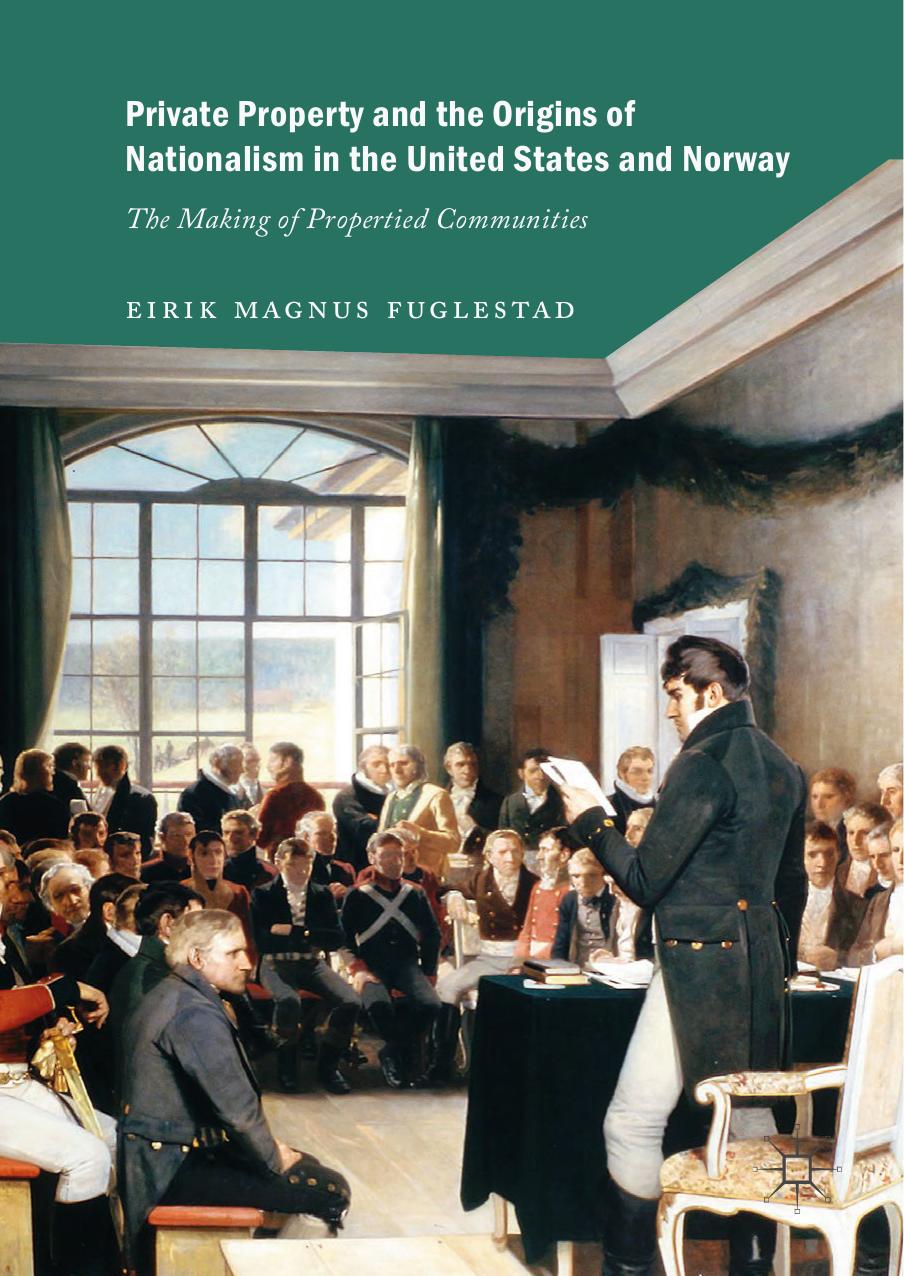
Private Property and the Origins of Nationalism in the United States and Norway by Eirik Magnus Fuglestad
Author:Eirik Magnus Fuglestad
Language: eng
Format: epub, pdf
Publisher: Springer International Publishing, Cham
The security of property for the propertied man was also the same for someone who did not have property. For, as Wergeland explained, the nation gave everyone this right: the fatherland was the source of all the power a citizen had, it gave him freedom of religion and of speech, andThe right to enjoy the fruits which groweth from his sweat, to be secure in his goods and his person, to stand up against whoever subdues right, even if he wears a crown.115
The Norwegian had the right to be “secure in his goods and in his person”—the Norwegian was, in other words, free under his constitution; toward the end of the poem, Wergeland asked the Norwegian, “What are you?”, and he answered, “Freeborn northman … slavery I hate more than the pest … my father placed my cradle under the sun of liberty.”116 Freedom from slavery meant to live in a state where the right to property was sacred. This being so in Norway, “the working man” was bestowed with “civic honor,” and he was “equal to his master in right and rank” to acquire property, a right which was maintained through “reverence to the law – the highest authority, king of the Norwegians.”117
In Wergeland ’s romantic vision, there was perhaps no material restrictions to who could be a lawmaker (“I believe that to the parliament, elections should not be by rank, but decided by the degree of enlightenment of a man,” he wrote in his Catechism),118 but, as we saw, real property was set as a central qualification to participate in legislation by the 1814 generation. Wergeland also hinted at the importance of landed property for the existence of freedom . In his History of the Constitution (Norges Constitutions historie, 1841), he referred to the odelsrett and the odelsbonde and contrasted the freedom that this right conferred on men against the subjugation of despotic rule. The Norwegians, wrote Wergeland in the first volume of his history, were a “people of odelsmænd, with such a simple and patriotic fear and unwillingness against the corrupting forces of the Danish despotic rule.”119 For such people, the constitution as given at Eidsvoll (with its property rights qualifications for the vote) in 1814 was in perfect correspondence with their nature, because it represented their ancient propertied freedom: “The Norwegian people did not see the constitution as something new and strange; but rather as a restoration, as a restitio in intergum, of the old internal state, of its ancient freedom.”120 The emphasis and importance placed on landed property must be understood in relation to the agrarian landed context in which the national movement worked, and indeed for almost half a century there was a consensus in the national movement that the constitution of 1814, with its property qualifications for enfranchisement, was the best way to secure freedom. It was this that constituted popular sovereignty . Indeed, from 1814 till 1869, no attempts were made by the parliament to fundamentally alter the franchise.121
Download
Private Property and the Origins of Nationalism in the United States and Norway by Eirik Magnus Fuglestad.pdf
This site does not store any files on its server. We only index and link to content provided by other sites. Please contact the content providers to delete copyright contents if any and email us, we'll remove relevant links or contents immediately.
| Africa | Americas |
| Arctic & Antarctica | Asia |
| Australia & Oceania | Europe |
| Middle East | Russia |
| United States | World |
| Ancient Civilizations | Military |
| Historical Study & Educational Resources |
Cat's cradle by Kurt Vonnegut(15363)
Pimp by Iceberg Slim(14520)
4 3 2 1: A Novel by Paul Auster(12401)
Underground: A Human History of the Worlds Beneath Our Feet by Will Hunt(12101)
The Radium Girls by Kate Moore(12035)
Wiseguy by Nicholas Pileggi(5793)
The Fire Next Time by James Baldwin(5454)
Perfect Rhythm by Jae(5410)
American History Stories, Volume III (Yesterday's Classics) by Pratt Mara L(5312)
Paper Towns by Green John(5195)
Pale Blue Dot by Carl Sagan(5013)
A Higher Loyalty: Truth, Lies, and Leadership by James Comey(4966)
The Mayflower and the Pilgrims' New World by Nathaniel Philbrick(4508)
The Doomsday Machine by Daniel Ellsberg(4493)
Killers of the Flower Moon: The Osage Murders and the Birth of the FBI by David Grann(4451)
The Sympathizer by Viet Thanh Nguyen(4398)
Too Much and Not the Mood by Durga Chew-Bose(4352)
The Borden Murders by Sarah Miller(4330)
Sticky Fingers by Joe Hagan(4205)
